AI in the Lab: Why It Matters Now
Write your awesome label here.
Artificial intelligence and machine learning training for laboratory operations
Artificial intelligence is no longer experimental—it’s operational.
Today’s laboratories generate massive volumes of data from LIMS, instruments, workflows, QC systems, and personnel activities. The labs that learn how to leverage AI and machine learning effectively will reduce inefficiencies, improve quality control, and make faster, smarter decisions.
This course provides practical AI training for lab managers, directors, and operations leaders who want to understand:
If you want to move from reactive data review to predictive and prescriptive lab management, this is where you begin.
Today’s laboratories generate massive volumes of data from LIMS, instruments, workflows, QC systems, and personnel activities. The labs that learn how to leverage AI and machine learning effectively will reduce inefficiencies, improve quality control, and make faster, smarter decisions.
This course provides practical AI training for lab managers, directors, and operations leaders who want to understand:
- How AI systems actually work
- Where AI delivers measurable operational impact
- How to start implementing AI responsibly
- What risks exist—both in adopting and avoiding AI
If you want to move from reactive data review to predictive and prescriptive lab management, this is where you begin.
-
Area of Study
Lab AI Strategy & Readiness
-
Course Duration
1-2 hours
-
CEUs
0.2
Proudly developed in partnership with Yahara Software
Why artificial intelligence training is essential for modern laboratory management
What you will learn in this laboratory AI training course
By the end of this course, engaged learners should be able to:
Key benefits of this AI and machine learning course for labs
AI readiness is only the beginning of modern laboratory leadership.
Learn from Yahara Software’s laboratory AI and data system experts
Watch the first module free: Click the introduction video to begin
Inside the course: AI in the lab–why it matters now for laboratory management and operations
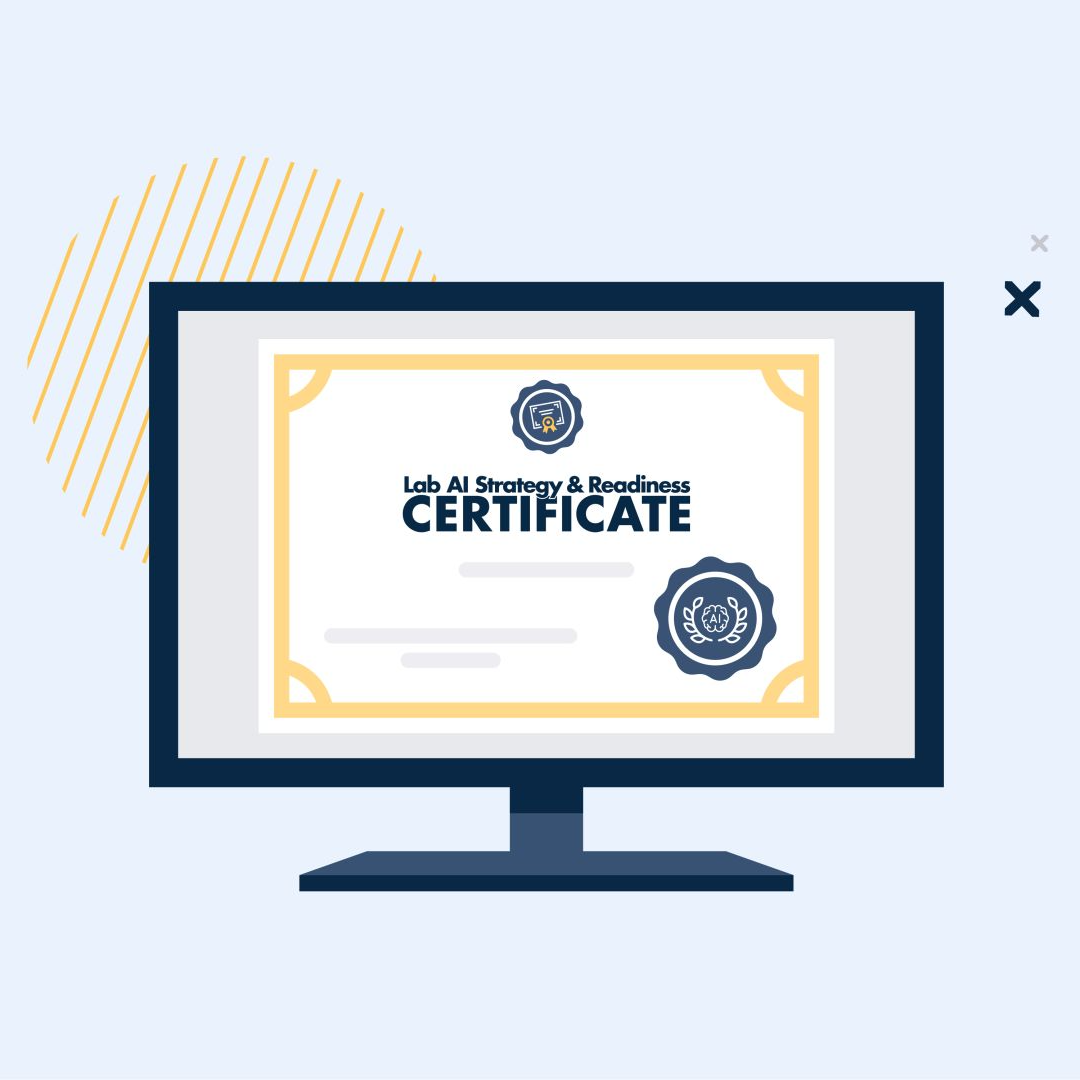
Take the next step: The Lab AI Strategy & Readiness Certificate
Understanding why AI matters is just the beginning. Successfully implementing artificial intelligence in laboratory operations requires strategic planning, data readiness, risk evaluation, and responsible leadership.
The Lab AI Strategy & Readiness Certificate is a comprehensive 5-course program designed to equip laboratory leaders with the knowledge and frameworks needed to evaluate, select, and implement AI solutions confidently. Move beyond awareness and develop a structured AI implementation strategy for your lab.
The Lab AI Strategy & Readiness Certificate is a comprehensive 5-course program designed to equip laboratory leaders with the knowledge and frameworks needed to evaluate, select, and implement AI solutions confidently. Move beyond awareness and develop a structured AI implementation strategy for your lab.
Frequently asked questions about AI in laboratory operations
Who should take this laboratory AI course?
This course is designed for lab managers, laboratory directors, QA/QC leaders, operations managers, scientific leaders, and decision-makers responsible for laboratory performance and data-driven strategy. It is ideal for professionals who want to better understand artificial intelligence and machine learning for laboratory operations before implementing AI tools in their environment.
Do I need a technical or data science background to take this course?
No. This laboratory AI training is built specifically for laboratory professionals—not data scientists or software engineers. The course focuses on practical applications of artificial intelligence in lab environments, using clear explanations and operational examples rather than technical coding instruction.
Does this course cover real-world AI use cases for laboratories?
Yes. You will explore practical AI applications across laboratory operations, including predictive analytics for quality control systems, sample routing optimization, inventory forecasting, compliance documentation automation, and operational performance improvement.
How is artificial intelligence different from traditional laboratory software?
Traditional laboratory software systems are largely rule-based and static. AI systems, by contrast, are dynamic and data-driven. They require ongoing monitoring, validation, retraining, and governance. This course explains how AI systems function as evolving ecosystems within laboratory environments and what that means for leadership oversight.
Does this course earn CEUs?
Yes. Lab Manager Academy is accredited by the International Accreditors for Continuing Education and Training (IACET). Completion of AI in the Lab: Why It Matters Now awards 0.2 Continuing Education Units (CEUs), allowing you to document recognized professional development in laboratory AI and machine learning training.
Can I enroll in this course individually?
No. This course is part of the Lab AI Strategy & Readiness Certificate, a comprehensive 5-course program designed to help laboratory leaders evaluate, plan, and implement AI initiatives responsibly.
Was this laboratory AI course developed with industry experts?
Yes. AI in the Lab: Why It Matters Now was developed in partnership with Yahara Software, a technology firm specializing in scientific application development, laboratory data systems, and AI-driven solutions for life sciences organizations.
The course content is informed by real-world experience designing and implementing artificial intelligence and machine learning systems across biotechnology, pharmaceutical, healthcare, and research environments. This partnership ensures the training reflects practical AI implementation strategies for laboratory operations—not just theoretical concepts.
The course content is informed by real-world experience designing and implementing artificial intelligence and machine learning systems across biotechnology, pharmaceutical, healthcare, and research environments. This partnership ensures the training reflects practical AI implementation strategies for laboratory operations—not just theoretical concepts.
Does this course count toward a larger AI certificate program?
Yes. This course is a core module within the Lab AI Strategy & Readiness Certificate, a structured program focused on AI fundamentals, data readiness, risk mitigation, strategic implementation, and responsible governance in laboratory environments.
How do I start implementing AI in my laboratory?
Successful AI implementation in laboratories begins with understanding your data maturity, defining clear operational goals, and identifying high-impact use cases such as quality control monitoring or inventory forecasting. This course helps you evaluate AI readiness, assess risks, and build a practical AI implementation strategy before investing in tools or vendors.
What is AI readiness for laboratories?
AI readiness refers to a laboratory’s ability to support artificial intelligence systems through structured data, governance processes, validation protocols, and leadership oversight. Without proper data infrastructure and monitoring frameworks, AI tools cannot deliver reliable results. This course explains the key components of AI readiness for laboratory operations and how to assess your current state.
How can machine learning improve laboratory quality control?
Machine learning enhances laboratory quality control by identifying patterns and anomalies that may not be visible through traditional rule-based systems. Predictive analytics models can detect QC drift early, reduce errors, and prevent costly rework. This course explores how AI-driven quality control systems evolve from descriptive reporting to predictive and prescriptive analytics.
Is artificial intelligence compliant with laboratory regulations?
AI systems can support regulatory compliance, but they require proper validation, monitoring, and documentation. Unlike traditional software, machine learning models must be continuously evaluated to ensure accuracy and reliability. This course discusses governance considerations, validation practices, and oversight frameworks necessary for compliant AI implementation in laboratory environments.
Why this AI course is different
Unlike generic AI training, this course was developed in collaboration with Yahara Software, whose team designs and deploys AI systems for real laboratory environments. You’ll learn from practitioners actively building AI solutions—not theorists.
Lab Manager Academy is accredited by the International Accreditors for Continuing Education and Training (IACET) and offers IACET CEUs for its learning events that comply with the ANSI/IACET Continuing Education and Training Standard. IACET is recognized internationally as a standard development organization and accrediting body that promotes quality of continuing education and training.